Circularity Over Carbon: Where Research Meets Practice at the Construction Congress in Aachen
Circularity Over Carbon: Where Research Meets Practice at the Construction Congress in Aachen
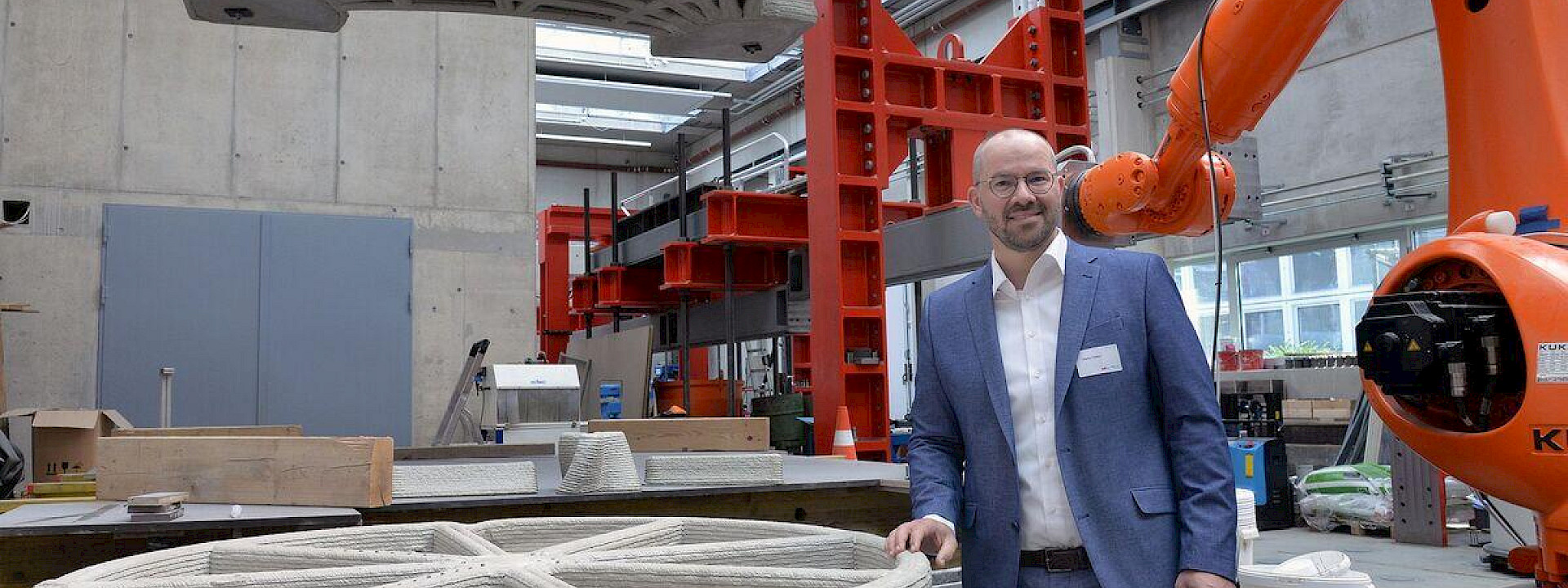
Attendees at this year’s Construction Congress will come away with a deeper understanding of the innovations reshaping the industry across three critical areas: sustainability, automation, and digitalization. A highlight of the program is the keynote address by Professor Martin Claßen, director of the Institute for Solid Construction at RWTH Aachen University (IMB) and co-spokesperson—alongside Professor Viktor Mechtcherine from TU Dresden— for the CARE Cluster of Excellence. We sat down with Professor Claßen to discuss the forces driving change in the built environment.
Where is the construction industry’s transformation most visible today—and where is the pressure to innovate most acute?
What’s becoming increasingly clear is that the industry can no longer think in terms of isolated materials or individual structures. It has to consider the entire material and value chains. And the pressures are converging all at once: the industry needs to become more climate-neutral, more productive, and more resilient—all while facing a growing skilled labor shortage and aging infrastructure. The real hotbeds of innovation are at the intersections of digitalization, automation, and resource efficiency. That means new manufacturing processes, data-driven planning and monitoring and, critically, finding ways to extend the life of existing structures and keep materials in circulation.
What developments are opening up the biggest opportunities in both new construction and existing building stock?
The greatest opportunities right now come from strategically combining new construction with preservation and reuse. On the new construction side, digital fabrication, robotics, and advanced materials are enabling structures that use significantly fewer resources and achieve far greater precision.
When it comes to existing buildings, the opportunity lies in slowing down the impulse to demolish. By using data to accurately assess a building’s load-bearing capacity, we can identify opportunities for selective reuse and retrofitting. Structural reuse—repurposing entire building components and load-bearing systems—is moving from a fringe concept to a genuinely viable model for the future.
How are technological innovations driving productivity gains across the industry?
Construction has historically been one of the least automated industries out there. But that’s beginning to change. New technologies are making it possible to digitally integrate planning, fabrication, quality assurance, and operations into a single, connected workflow. Robotic manufacturing, additive processes such as 3D concrete printing, sensor-embedded components, and AI-powered data analysis are all playing a role. The result is construction processes that are more precise, faster, and far more resource-efficient. The long-term vision is a shift from highly manual, project-by-project workflows toward industrialized, data-driven production systems.
What can the construction industry learn from more heavily automated sectors?
There’s a lot of inspiration coming from automotive, aerospace, and advanced manufacturing. However, the key is adapting those lessons to the complexity and customization that define construction. Going forward, the industry will rely more heavily on prefabricated, modular, digitally engineered components. That means custom digital process chains, precision robotic fabrication, and more consistent quality management standards. Simulation tools, sensor networks, and real-time data will also become essential for continuously monitoring and optimizing how projects come together on the ground.
What kind of momentum are reuse strategies and the circular economy generating for more sustainable construction?
There’s a fundamental shift in how we think about buildings. For a long time, they’ve essentially been treated as future waste. Increasingly, they’re being recognized as material reservoirs. Reuse strategies are reshaping how we approach design, deconstruction, and construction itself. Building components need to be identifiable, verifiable, and ready for a second life. At the same time, new digital tools are emerging to catalog material data and assess the structural soundness of existing buildings. The circular economy is no longer just an environmental imperative—it’s becoming a genuine engine of technological and economic innovation for the construction industry as a whole.
Press contact
B.Sc. Carolin Peschke
Science Communication Officer
RWTH Aachen University Chair and Institute of Structural Concrete