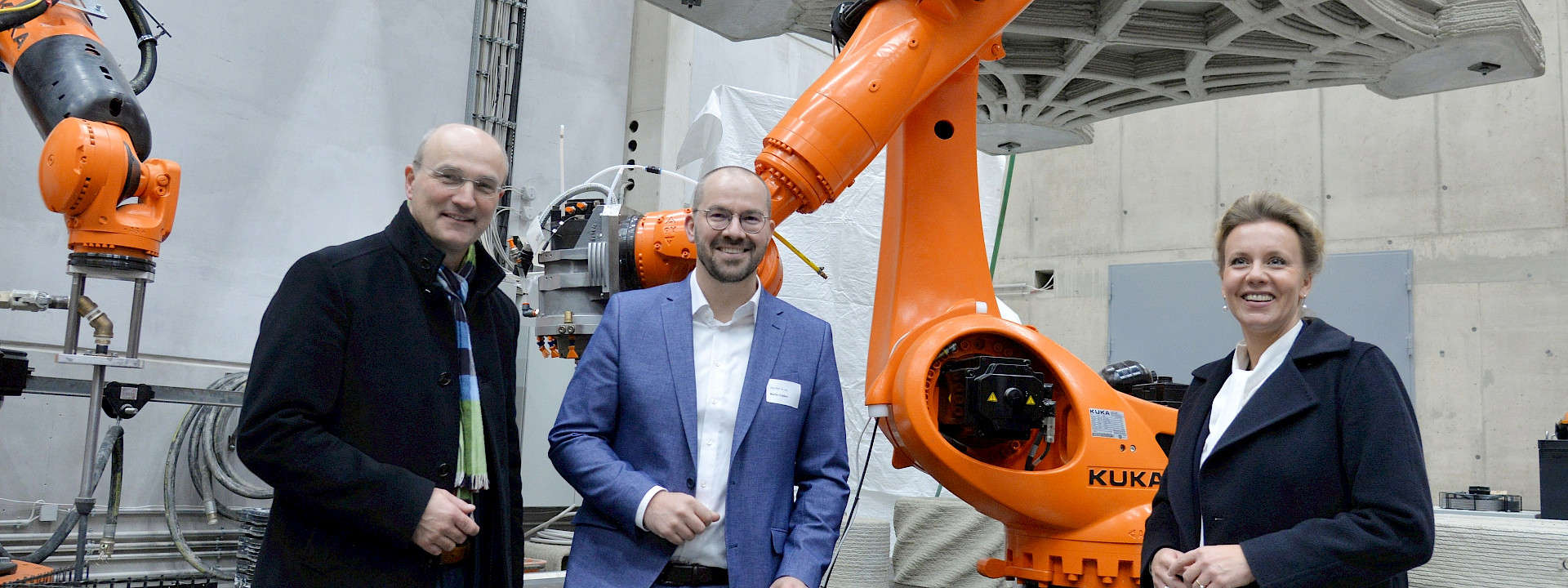
When North Rhine-Westphalia’s Minister of Science and Culture, Ina Brandes, attends a Borussia Dortmund soccer match, she often crosses the same pedestrian bridge—always with a hint of unease. The structure is aging, and its condition is uncertain. On Wednesday afternoon, Brandes visited RWTH Aachen University to learn how researchers at the Climate-Neutral and Resource-Efficient Construction (CARE) Cluster of Excellence are developing solutions for exactly these types of challenges—and to explore other innovations shaping the future of construction.
Professor Martin Claßen, head of the Institute of Structural Concrete, welcomed the minister to CARE, which he co-leads together with Professor Viktor Mechtcherine from Dresden University of Technology (TUD). He presented how researchers from both universities are developing the construction methods of tomorrow—sustainable, circular, resource-efficient, and intelligent—and how the team is rethinking building and infrastructure from the ground up. “RWTH is addressing these critical societal challenges,” said RWTH Rector Ulrich Rüdiger during the visit.
After a brief introduction to the research topics addressed by CARE, the minister moved on to hands-on research demonstrations. She saw robots that 3D-print concrete components using only one-third of the usual material, self-monitoring smart support structures, and a vibration table capable of simulating earthquakes.
Claßen explained how his team is advancing modular and recyclable components, material-efficient design, digital and automated construction processes, alternative construction materials, and even building systems that actively remove CO₂ from the atmosphere: “Our goal is to fundamentally transform how we build,” he said.
Brandes left visibly impressed: “I had heard much about the theory, but today I was able to experience the future of sustainable and automated construction firsthand. I am truly impressed by the research taking place here.”
She emphasized that the solutions developed at RWTH in collaboration with the Dresden team could help address urgent challenges in North Rhine-Westphalia—particularly deteriorating infrastructure and the shortage of skilled workers. Her conclusion was clear: “The sooner these research results can be put into practice, the better for our federal state and Germany.”
And what about her nervous bridge crossings in the future? The answer may lie in smart, self-monitoring bridges, equipped with sensor grids that continuously assess structural health. This technology is ready for real-world use today. During her tour of the Institute of Structural Concrete test hall, Brandes examined prototype elements up close and pledged support in navigating regulatory and approval processes for such innovations.