Abstract
Digital fabrication with earth-based materials represents a promising pathway toward circular, low-carbon construction. However, most applications remain non-structural due to earth’s low tensile strength as well as pronounced drying shrinkage and moisture sensitivity. FRAME develops reinforced earthen composites that remain reusable and biologically compatible while achieving the structural performance required for load-bearing components.
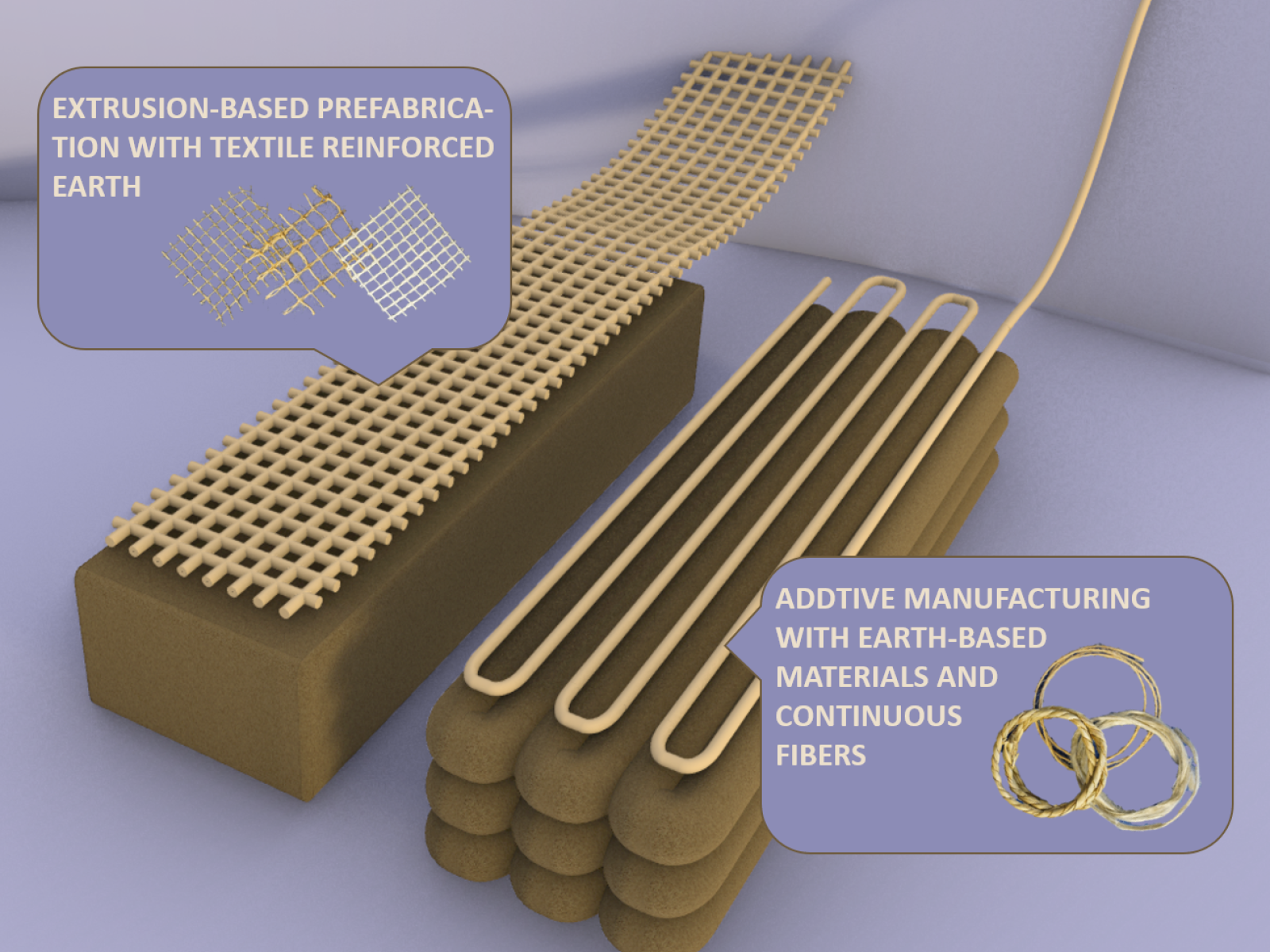
The project combines short natural fibers in the matrix with continuous natural yarns and textile reinforcements integrated during fabrication. Two processing routes are investigated. Robotic additive manufacturing embeds continuous yarns to create oriented reinforcement for both on-site and prefabricated elements. Extrusion-based prefabrication integrates textile reinforcements within and between layers under controlled conditions. Short fibers stabilize the fresh mix, enhance interlayer bonding, and reduce early-age cracking.
Multi-scale characterization quantifies earth-fiber interfaces, bonding mechanisms, and moisture transport. These results are linked to rheological properties that define process windows with respect to printability and extrudability. Mechanical performance is assessed from specimen to component scale and translated into design principles and calculation approaches. Natural additives are screened to enhance water resistance and fiber-matrix adhesion without compromising recyclability.
FRAME also explores the acceptance of combining traditional earthen materials with digital fabrication. The project culminates in a full-scale demonstrator employing exclusively natural fiber reinforcement systems for structural elements.