Skip Navigation

D-CONFORM

Digitales Bauen unter Verwendung von verstärktem, kohlenstoffarmem Mineralschaum

Abstract

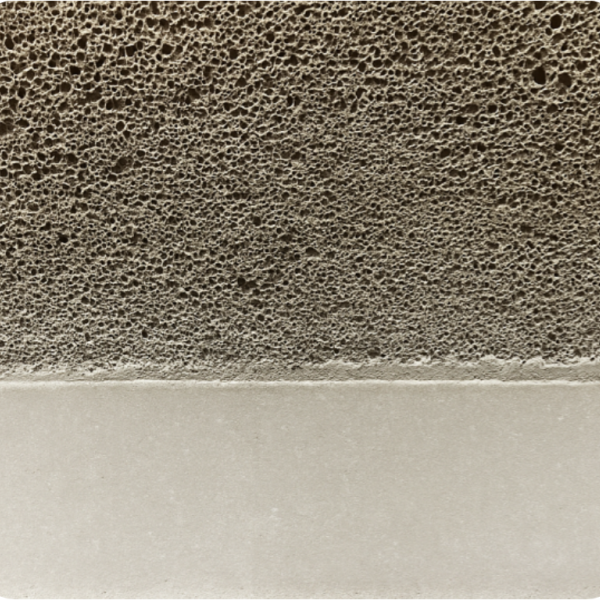
This project advances digital construction by developing low-carbon mineral foam for 3D-printed structural applications. By combining CO₂-based foam and LC3 (Limestone Calcined Clay Cement) binders with material-efficient design strategies, the project aims to enable climate-neutral and resource-efficient construction systems. To address key challenges related to foam stability during pumping, a novel near-nozzle production concept for printable CO₂-based mineral foam is investigated. This approach is explored through coordinated research on material formulation and custom print-head design.

At the micro- and meso-scale, high-resolution computed tomography and scanning electron microscopy are used to gain detailed insight into the internal pore structure of the mineral foam. These imaging datasets are analyzed using machine-learning methods to quantitatively characterize pore morphology and support systematic mix design optimization. In parallel, at the macro-scale, digital form-finding and topology optimization techniques are developed to generate load-efficient, 3D-printable geometries that minimize material consumption while maintaining structural performance.

Finally, representative prototypes will be fabricated using the CARE Physical Platform Prefab Plant, with a clear pathway toward upscaling and future on-site implementation. Overall, the project delivers an integrated multidisciplinary research platform, spanning material science, construction machinery, computational and structural design, for advancing sustainable digital construction.

Das Team hinter dem Projekt

  • Shravan Muthukrishnan
    Jun.-Prof. Dr.
    Shravan Muthukrishnan
    Principal Investigator
    TU Dresden
    Institut für Baustoffe

    shravan.muthukrishnan@tu-dresden.de
  • Jan Bielak
    Dr.-Ing.
    Jan Bielak
    Principal Investigator
    RWTH Aachen
    Lehrstuhl und Institut für Massivbau

    jbielak@imb.rwth-aachen.de
  • Frank Will
    Prof. Dr.-Ing.
    Frank Will
    Principal Investigator
    TU Dresden
    Professur für Baumaschinen

    frank.will@tu-dresden.de
  • Björn Andres
    Prof. Dr. rer. nat.
    Björn Andres
    Principal Investigator
    TU Dresden
    Professur für Maschinelles Lernen für Computer Vision

    bjoern.andres@tu-dresden.de
  • Stefan Kaskel
    Prof. Dr. rer. nat. habil.
    Stefan Kaskel
    Principal Investigator
    TU Dresden
    Professur für Anorganische Chemie I

    stefan.kaskel@tu-dresden.de
  • Silvia Reißig
    Dipl.-Ing.
    Silvia Reißig
    Wissenschaftliche:r Mitarbeiter:in
    TU Dresden
    Institut für Baustoffe

    silvia.reissig@tu-dresden.de
  • Niklas Müller
    M.Sc.
    Niklas Müller
    Wissenschaftliche:r Mitarbeiter:in
    RWTH Aachen University
    Lehrstuhl und Institut für Massivbau

    nmueller@imb.rwth-aachen.de
  • Paul Plaschnick
    Dipl.-Ing.
    Paul Plaschnick
    Wissenschaftliche:r Mitarbeiter:in
    TU Dresden
    Professur für Baumaschinen

    paul.plaschnick@tu-dresden.de
  • Florian Storch
    Dipl.-Ing.
    Florian Storch
    Wissenschaftliche:r Mitarbeiter:in
    TU Dresden
    Professur für Baumaschinen

    florian.storch@tu-dresden.de
  • Johannes Plaßmann
    Dipl.-Ing.
    Johannes Plassmann
    Wissenschaftliche:r Mitarbeiter:in
    TU Dresden
    Professur für Baumaschinen

    johannes.plassmann@tu-dresden.de
  • David Stein
    M.Sc.
    David Stein
    Associate
    TU Dresden
    Professur für Maschinelles Lernen für Computer Vision

    david.stein1@tu-dresden.de
  • Sibo Chetry
    Ph.D.
    Sibo Chetry
    Wissenschaftliche:r Mitarbeiter:in
    TU Dresden
    Professur für Anorganische Chemie I

    sibo.chetry@tu-dresden.de
  • Anna Jose
    M.Sc.
    Anna Jose
    Associate
    TU Dresden
    Institut für Baustoffe

    anna.jose@tu-dresden.de