Abstract
The broader use of composite cements is a key lever for reducing CO₂ emissions in the construction sector. Their application, however, is often limited by slow early-age strength development, as the pozzolanic reaction of supplementary cementitious materials proceeds more slowly than the hydration of clinker-rich cements. Sustainable and broadly applicable acceleration methods are still lacking.
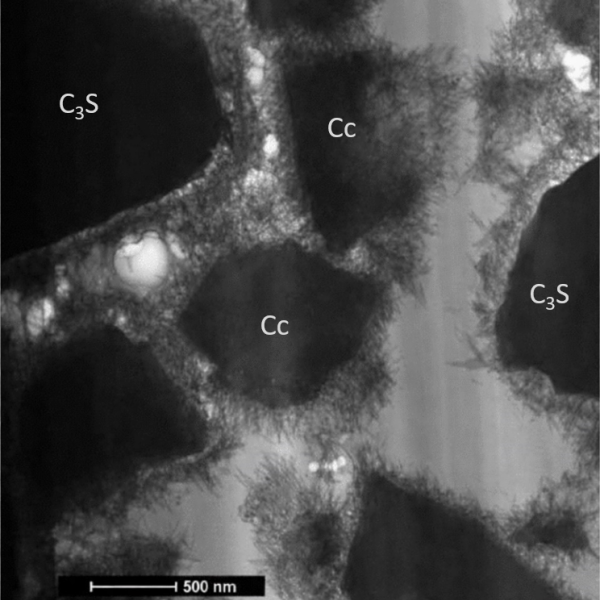
This project addresses this challenge by investigating a CO₂ mineralization–based acceleration approach applied to different cement systems, including Portland cement, two composite cements, and a calcined clay limestone cement. CO₂ is injected directly into the mixing process to generate fine nucleation seeds that promote faster formation of calcium-silicate-hydrates. The performance of this approach is benchmarked against commercially available hydration-accelerating admixtures (e.g., Master X-Seed), with the aim of achieving early-age strength development comparable to Portland cement within the first 10 hours.
In parallel, the project develops data-driven methods to assess early-age strength development. In-situ sensor data capturing physical and chemical changes during hardening are combined with mixture and material parameters. Bayesian modeling frameworks are used to predict early-age compressive strength in situ, enabling robust predictions with limited experimental data.